
Multi-location SEO for mental health clinics is often discussed, but rarely explained the way it unfolds in real scenarios.
Most guides will tell you what to do.
But very few explain why things break when you start managing 10, 15, or 20 clinic locations at once.
So how this is going to be different?
Because it is based on real execution.
I’m currently leading SEO for multiple clinics, overseeing more than 16 mental health clinic locations across Ohio.
What I’m sharing here is not theory or a recycled framework.
These are observations from managing and ranking location pages, Google Business Profiles, and local trust signals sucessfully while staying compliant in a healthcare environment.
Why Multi-Location SEO Becomes Complicated for Mental Health Clinics?
Managing local SEO for a single therapy clinic is straightforward. The website structure and the hierarchy is to explain and simple to execute.
Once you scale to multiple locations, the challenges compound quickly.
Therapists may rotate between clinics. Services are not always uniform. Reviews need to be handled carefully. And tracking options are limited due to HIPAA compliance.
This is where most multi-location strategies fail.
They rely on duplication instead of structure, and automation instead of governance.
Location Pages Are The Foundation of Multi-Location SEO
For the startign, amke sure that every mental health clinic location has its own dedicated location page.
This is not optional. It’s mandatory.
A location page serves two purposes at the same time:
- It helps patients understand the clinic they are visiting
- It gives Google Business Profiles a reliable page to connect with
From a patient’s perspective, this page answers very practical questions.
- Where is the clinic?
- Who provides care there?
- What services are offered at this location?
- How do I get there?
From an SEO perspective, this page becomes the authority signal for that clinic.
Also Read: How to Do Local SEO for Therapists (Examples Included)
What Actually Makes a Location Page Work
Remember, a mental health location page should feel local.
That means embedding a Google Map, clearly showing driving routes, and using real photos of the office, not stock imagery. Patients want reassurance before booking, and Google looks for real-world signals.
Each page should also clearly highlight:
- Services offered at that specific location (as you already know services often varies from location to location).
- Therapists serving that clinic
- Location-specific clinic reviews
Local schema is essential here. Using the correct LocalBusiness or MedicalBusiness schema helps search engines understand that this page represents a real, physical healthcare location.
Structure Matters More Than Content Volume
When you manage multiple clinics, structure of the lcaotion page becomes more important than writing more content.
Based on my own observation, I prefer a replicable location page framework. The layout, hierarchy, and technical setup should remain consistent across locations. What changes is the local information.
This allows us to scale without creating duplicate content issues or internal confusion. It also makes updates easier when services change or clinics expand.
Consistency at the system level, localization at the content level. this balance is critical.
Google Business Profiles (GBPs) Should Focus Precision Over Aggression
Google Business Profile is the most powerful local SEO asset for mental health clinics. It is also the easiest place to make mistakes.
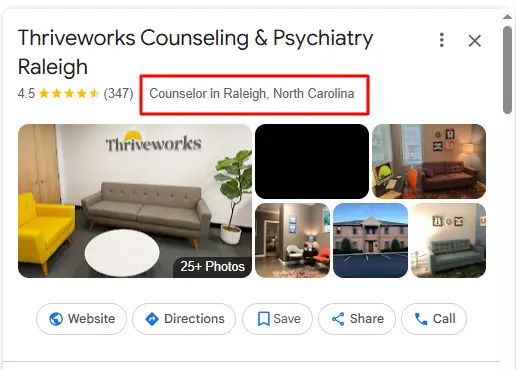
Category selection is critical. Choosing the wrong primary category can confuse Google and misrepresent the clinic’s services. This directly affects visibility in the local map pack.
Posting activity should be intentional. Buttons should link to:
- The correct location page
- A relevant service page
- Or a HIPAA-compliant booking system
I do not recommend using Google Tag Manager or aggressive UTM tracking for mental health clinics. GTM is not HIPAA compliant, and over-tracking introduces unnecessary risk. Accuracy and patient privacy should always come first.
Also Read: How to Measure Local SEO Success for Therapists
Your GBP Posts Should Reflect the Local Community
Generic Google Business Profile (GBPs) posts do not perform well for mental health clinics.
The posts that work best are localized and community-focused. This includes:
- Hosting or participating in local events
- Community workshops
- Clinic-led initiatives
- and most importantly Services offered
Using real images from these events and reflecting them both on the GBP and the location page creates consistency. This alignment strengthens trust signals and reinforces the clinic’s local presence.
Reviews Must Be Location-Specific
Reviews play a major role in how patients choose a mental health clinic. In multi-location setups, they also play a major role in how Google understands local relevance.
One of the most common issues I see is clinics collecting reviews at a brand level, without clearly tying them back to individual locations. When this happens, trust weakens and local visibility suffers.
A patient doesn’t want to know how the brand performs overall.
They want to know how this specific clinic feels, operates, and supports people like them.
That’s why reviews must always be location-specific.
Each clinic location should prominently display its own reviews, both on the Google Business Profile and on the corresponding location page. When patients see feedback tied to a real office, it creates reassurance before the first appointment.
To do this at scale, clinics need a system — not ad-hoc requests.
Using a standardized review request template ensures consistency across locations while still keeping the language ethical and patient-friendly. This makes it easier for front-desk staff and therapists to follow the same process without improvisation.
Physical clinics should also make use of QR codes placed at reception desks or in signage. A simple scan that leads directly to the correct Google Business Profile removes friction and increases review completion rates.
Just as important is what not to do.
Review gating: asking only happy patients to leave reviews violates Google’s guidelines and puts the entire profile at risk. Reviews should be requested uniformly, without filtering or pressure, and never in a way that compromises patient comfort.
When reviews are collected ethically, tied to the correct location, and supported by a repeatable process, they strengthen both patient trust and local SEO, without creating compliance risks.
Backlinks and Citations Are Local Signals That Can Outrank Big Players Lifestance Therapy
In mental health SEO, citations and backlinks are not just “nice-to-have” — they are essential for local authority and visibility.
Take Psychology Today for example. It dominates almost every therapy-related search query. Type in “anxiety therapist near me” and it will almost always appear at the top of Google Search results. But here’s the catch: Psychology Today rarely shows up in the Google Map Pack. Why? Because it’s a national directory, not a local business. Google’s Map Pack favors verified, location-specific businesses with accurate NAPs, local content, and community signals.
Now look at local chains like Lifestance Therapy. Their model is different — each location is treated as a physical business. That’s why they consistently appear both in Search and in the Google Map Pack. Their local presence, properly verified Google Business Profiles, and location-specific pages give them a strong advantage over directories.
But even businesses like Lifestance can be outranked, if you approach it the right way and I have and I am doing this currently.
Here’s how you can do it:
- Citations at the location level: Every clinic location is listed accurately across directories, healthcare platforms, and local aggregators. This ensures Google sees each location as a trusted local entity.
- Backlinks focused on locality: Links from local organizations, community resources, and regional mental health initiatives point directly to the relevant location page, not just the homepage. This reinforces local relevance for search engines.
- Consistent systems: Templates for outreach, standardized NAPs, and regular audits make scaling multi-location SEO manageable without losing accuracy.
The result? Even against a strong local chain like Lifestance, smaller or newer clinics can win Map Pack rankings in their own cities by combining accurate citations, strategic backlinks, and optimized location pages.
Final Thoughts
Multi-location SEO for mental health clinics is not about shortcuts.
It is about structure, accuracy, and trust.
From managing 16 clinic locations, one thing is clear: clinics that succeed in local search are the ones that mirror the real world online. When your digital presence accurately reflects how your clinics operate, Google rewards that clarity.
If you are scaling a mental health practice, your SEO strategy needs to scale with the same care and precision you apply to patient outcomes.