
Most therapists have been there. You hire an SEO agency, you pay the monthly retainer, and every 30 days you receive a PDF filled with impressive-looking charts, upward-trending lines, and “green” metrics.
But on the ground, nothing has changed.
The phone isn’t ringing. There are no new discovery calls. Your “intake” inbox is empty. When you look closely at the reports, you see that your blog post about “Understanding CBT” is ranking #1 globally, but when you search for “CBT therapist near me,” your practice is nowhere to be found.
This is the SEO Reporting Gap. It happens when an agency focuses on “vanity metrics” (traffic and generic rankings) instead of “intent metrics” (local visibility and leads).
Therefore, to overcome this gap, I have put together this guide on how to measure Local SEO success for therapists. It helps to evaluate if your Local SEO strategy is actually working, or if you’re just paying for a monthly PDF.
The “Simple” Approach to SEO Reporting (What I do)
In my regular routine with clients, we don’t spend hours getting lost in complex software. I work exclusively with mental health professionals whose calendars are already full weeks in advance (because of the SEO work I do). They don’t have time for fluff.
But having said this, one thing is essential to metnion here.
I tend to use a different approach based on the comfort level and what the owners really agree to!
For instance, for clients like Minfully Behavioral Health, with whom I’ve been working for years, the approach is simple: we hold a bi-monthly meeting where we look at three things: an Excel sheet, Google Search Console (GSC), and the Google Business Profile (GBP) Dashboard.
I walk them through the results we have this month versus what we had last month. We identify the “wins” (where we moved up) and the areas for improvement. This keeps us grounded in reality and builds trust.
But for newer clients as like I am working currently with Therapy Austin, we do a comprehensive tracking using Google Analytics. We track the pages on which the users land and how they move from page to page. This is another way to have an extensive strategy to see what is working and what is not!
However, if you want to truly understand the “why” behind your growth; or why your current agency is failing you, you need to look at what we call Comprehensive Reporting.
With the consent of your SEO specialist or agency, you can agree on a specific set of metrics relevant to your practice.
Moving Toward Comprehensive Reporting
While the simple routine is great for day-to-day management, there are times when you need to go deeper, especially if you feel your current agency isn’t delivering.
If you want to truly understand your “Share of Voice” in a competitive market, you need what we call Comprehensive Reporting.
With the consent of your SEO specialist or agency, you can agree upon more advanced metrics. This doesn’t mean everything needs to be difficult; it just means you are agreeing on a “Source of Truth” that goes beyond simple traffic numbers.
This higher level of reporting helps you understand why the phone is ringing (or why it isn’t) by looking at how you are positioned against every other therapy provider in your service area.
Measuring Visibility: The “Map” vs. The “List”
For a local therapy practice, there are two different ways you appear on Google, and they must be measured differently.
The Local Pack (Google Maps)
The “Local Pack” is the box with the map and the top three business listings. For terms like therapist Raleigh, NC this is the most valuable real estate on the internet.
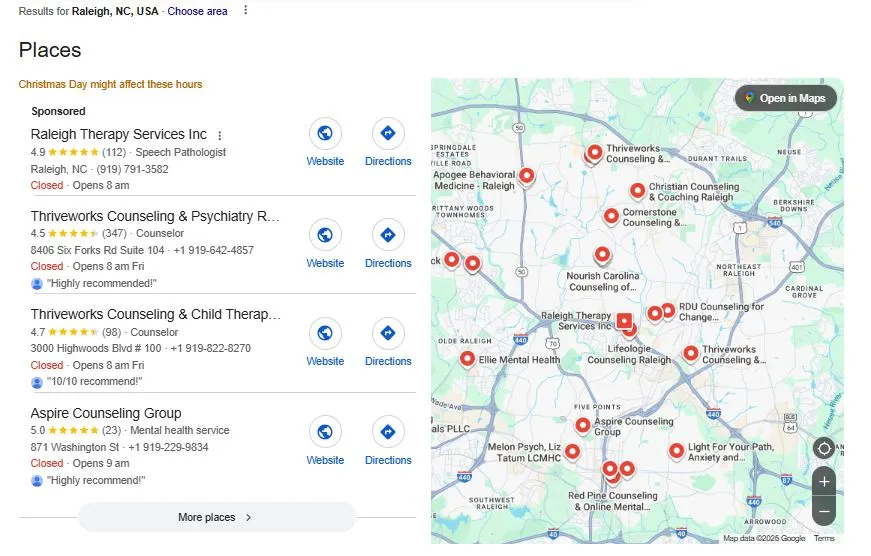
Traditional SEO reports will give you a single ranking number (e.g., “You are #2”). This is often misleading because map rankings change based on where the patient is standing. To measure this properly, your agency should be using a tool like Local Falcon or WhiteSpark to provide a Scan Report.
This report shows a geographic heatmap of your city. You can see exactly which neighborhoods see you in the top 3 (the “Green Zone”) and where you fall off the map. If your “Share of Local Voice” (SoLV) isn’t expanding into new zip codes each month, your SEO isn’t actually growing your local reach.
Also Read: How to Do Local SEO for Therapists (Examples Included)
Organic Rankings (The Search Results)
Below the map is the traditional list of websites. This is where your authority is measured. You want to see your website ranking for local location modifiers combined with your services. If your agency shows you are ranking for “What is anxiety?” but you aren’t on page one for anxiety therapy San Antonio, they are ranking you for the wrong things. Traffic is vanity; local intent is sanity.
Google Business Profile: Tracking Intent-Driven Actions
Your Google Business Profile (GBP) is often the last stop for a patient before they decide to reach out. It is the primary data source for AI Overviews and mobile search. If your agency is only reporting on “Profile Views,” they are hiding a lack of results.
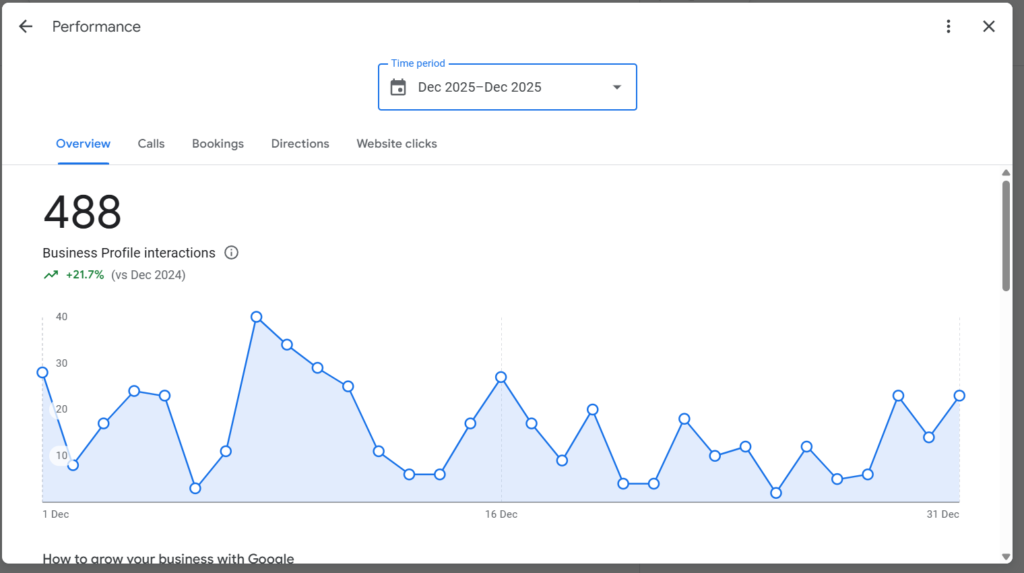
To measure success here, you must track Intent-Driven Actions:
- Direction Requests: This is a massive signal that someone is coming to your office location.
- Phone Calls: Direct clicks to call from the listing.
- Website Clicks: High-intent users who want to “vet” your expertise( I prefer this over calls because it helps to improve decision making and make the conversion funnel better).
Evaluation Tip: Ask your agency if they are monitoring your Review Velocity. To stay relevant to AI models and Google’s latest updates, you need a steady “heartbeat” of new, positive reviews. A 5-star rating from three years ago is considered “stale” and can actually lower your rankings compared to a competitor who gets two new reviews a month.
But reviews in mental healthcare are tricky, and you have to show an interest in the review gathering process.
Also Read: Why Your Behavioral Health Clinic Isn’t Ranking on Google Maps
AI Visibility: The New Frontier of Trust
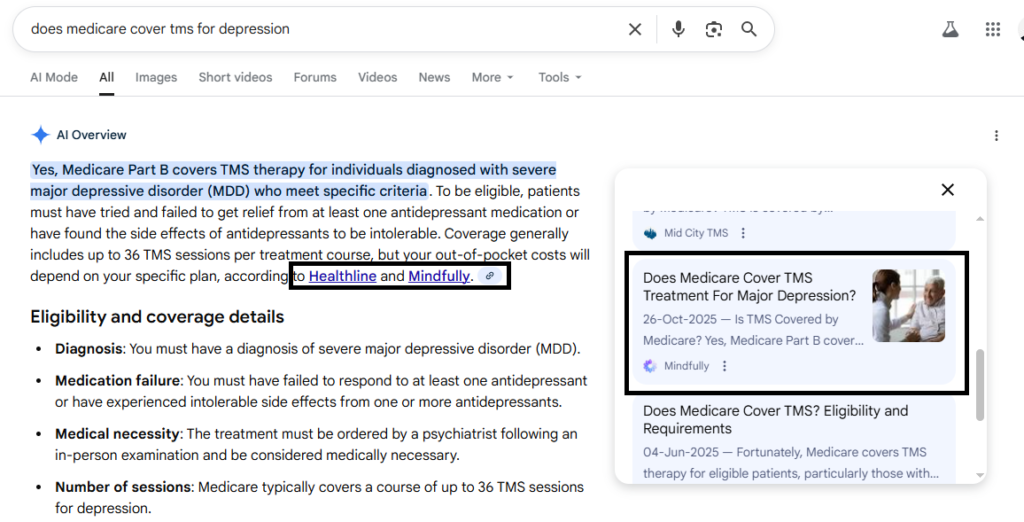
As we move into the era of AI SEO, we have to expand our KPIs (Key Performance Indicators). Your patients are increasingly using ChatGPT or Google’s AI Overviews to find help. These models don’t just “list” links; they “recommend” entities.
Also Read Mindfully Behavioral Health SEO Case Study
Measuring the “Mention Gap”
You need to know if AI models are citing your practice. AI models are trained to prioritize Institutional Trust. They look at the “Echo Chamber“. What do third-party sites say about you?
What to track:
- Share of AI Voice: How often is your practice mentioned in synthesized answers for therapists [city name]?
- Third-Party Citations: Ensure your practice is verified on niche platforms like Healthgrades, Psychology Today, and Zocdoc. If the AI sees you in all these places, it “believes” you are a legitimate local authority.
If your agency isn’t talking about “Machine Readability” or “Schema Markup” (the language AI speaks), they are ignoring the fastest-growing segment of search.
HIPAA-Compliant Reporting: Protecting Your Patients and Your Practice
This is perhaps the most important section of this guide. As a therapist, your measurement of success must be strictly gated by HIPAA compliance. Many general SEO agencies use standard tracking tools that transmit Protected Health Information (PHI) – like a patient’s IP address combined with a search for “trauma therapy” to third parties without a Business Associate Agreement (BAA).
Therefore, I suggest you to:
- Aggregate Data Only: Your SEO reports should never contain patient names, phone numbers, or specific medical details. You should see “12 appointment requests,” not “John Doe requested help with depression.”
- HIPAA-Compliant Tools: Ensure your agency is using compliant versions of tools. For example, CallRail HIPAA for call tracking or JotForm HIPAA for lead capture.
- No PHI in Reports: Success can be fully measured using anonymized data. We look at conversion rates as a percentage, not as a list of individuals.
If your agency cannot explain how they are protecting patient data in their reporting process, they are a liability to your clinic.
The Service Keyword Audit: Are You Ranking for the “Money” Keywords?
A common reason for an empty waiting room is that your SEO agency/consultant is ranking you for the wrong things. You must audit your keywords based on Local Intent.
The Red Flag: Your agency tells you that you rank #1 for “how to stop a panic attack.” This is a national keyword. It brings in “info-seekers,” not “patients.”
The Green Flag: You are ranking in the top 3 for panic disorder treatment Austin, TX. This is a “Money Keyword” because it shows the user is looking for a local provider now.
Action Item: Look at your Keyword Reports. If 50-60% of your rankings don’t include a location modifier like your city or neighborhood name, your SEO is not localized enough to fill your calendar.
Analyzing Results with Specialized Reports
When you go beyond the monthly Excel sheet and look at comprehensive data, there are four types of reports your agency should be able to provide via tools like Local Falcon as seen in the image attached.
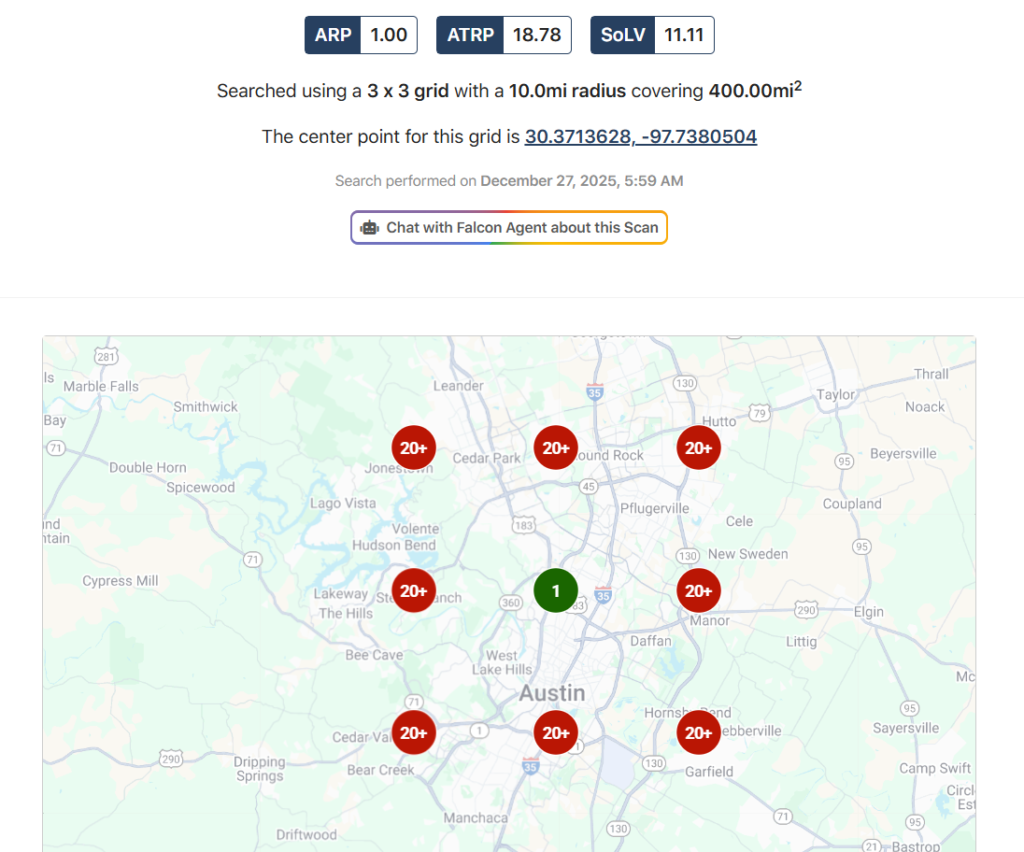
A. Competitor Reports
SEO is a zero-sum game. If you aren’t ranking, a competitor is. A Competitor Report compares your rankings directly against other therapy providers. It identifies who is taking your “Share of Voice” and what they are doing differently (e.g., more reviews or better local backlinks).
B. Trend Reports
Performance should be tracked over time. A single snapshot is just a moment in time. Trend Reports show you if your visibility is growing or shrinking over 6 to 12 months. This helps you understand if your investment is paying off long-term.
C. Keyword Reports
These focus on how you rank for specific services across multiple locations. If you have clinics in both Dallas and Austin, you need to see how you perform for each service in each distinct market.
D. Location Reports
This provides a complete snapshot of a single office location. It tracks all keywords, GBP insights, and reviews in one place. It’s the “health check” for your physical clinic’s digital presence.
The Ultimate Metric: Conversion Rate
At the end of the day, traffic and rankings mean nothing if they don’t convert. Your Conversion Rate is the percentage of visitors who take a desired action (calling, filling out a form, or booking an appointment).
Why it might be low:
- Poor Website Experience: Your site is slow or hard to navigate on a phone.
- Lack of E-E-A-T: You haven’t clearly displayed your credentials, experience, or specialized training.
- No Clear Call-to-Action: The “Book Now” button is hard to find.
A good consultant won’t just tell you the traffic is up; they will tell you how they are trying to improve the conversion rate so that the traffic actually turns into discovery calls.
Final Thoughts
Measuring Local SEO success for your therapy practice isn’t about the numbers; it’s about the patients. If your reports are full but your office is empty, the strategy is disconnected from your business goals.
By moving away from “vanity metrics” and focusing on a simple routine of checking GSC, GBP, supplemented by Comprehensive Reporting on map visibility and AI citations can ensure your SEO is a growth engine for your clinic.