
Local SEO for therapists is not the same today as it used to be.
The addition of AI-based search features like AI Overviews, AI-mode and inclination of users towards AI-generated search platforms like ChaGPT has significantly changed the very core of local search.
To stay relevant, you need a proactive strategy that is measurable and result oriented.
Based on my experience working as an SEO Consultant for mental health clinics and private therapy practices, I’ve put together this guide that is essential for therapists in 2026.
Why Local SEO Matters for Therapy Providers in 2026
Before going to Local SEO strategies, we have to understand the importance of Local SEO. Based on my personal observation, nearly 70–80% of patients will choose a therapist or mental health clinic within a 25–25 minute drive of their home or workplace.
In the language of SEO we call it Proximity (Distance to Searcher).
It is one of the core ranking factors for Google Local Map Pack. But proximity alone isn’t enough. You have to be the trusted option nearby.
Why?
Mental health services falls under Google’s “Your Money or Your Life” (YMYL) category. This means Google’s algorithm is far stricter with your clinic than it is with a local pizza shop.
And there are three elements where you have to show your credibility.
- First your Google Business Profile (GBP), accounts for almost 60 % of organic searches
- then we have traditional organic search,
- and then AI Overviews (initial phase but a lot of potential going forward in the near future).
For GBP, we are going to discuss the essentials in this blog.
AI Overview are summarized results on Google that help patients to see the credibility signals like reviews, years in business, and accepted insurance without even clicking your website.
Hence, you have to win the user’s trust before he lands on your website!
Also Read: How Can I Prepare My Healthcare Website For AI SEO
Make Your Google Business Profile (GBP) Stand-Out
Google Business Profile is the most important asset for therapists and counseling clinics trying to attract local patients.
It is what users see before clicking on the call or website option. But to see it, it needs to be ranked in the local map pack.
And how are we going to do that? That’s a question you should be exploring.
Before, we go on to that part, I want to show what I mean when I say GBP.
So let’s say you are living in Delware and your search for affordable therapist near me, here are the results that you’d see:
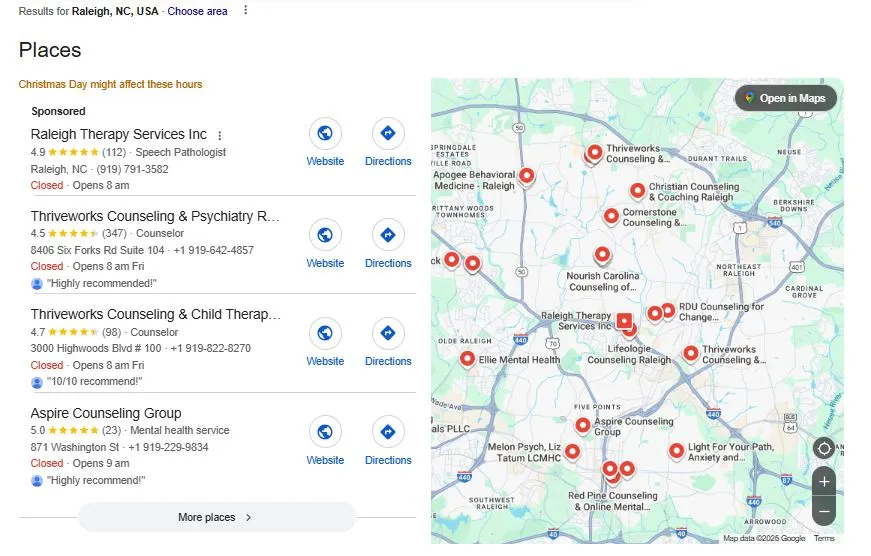
Now this search section is called Local Map Pack, and each result shown here is a Google Business Profile (GBP).
To rank in this section, here are the basic elements that you must ensure:
Choosing Primary Category:
Choosing the primary category is more important than many people think.
It is the #01 ranking factor for GBP.
How do you choose the right primary category for your business?
For instance, If you run a private therapy practice, Google may show options like:
- Mental Health Clinic
- Counselor
- Psychotherapist
- Psychologist
You can choose only one as the primary category.
But what is the right choice to have?
The best way is to see what your competitors are doing!
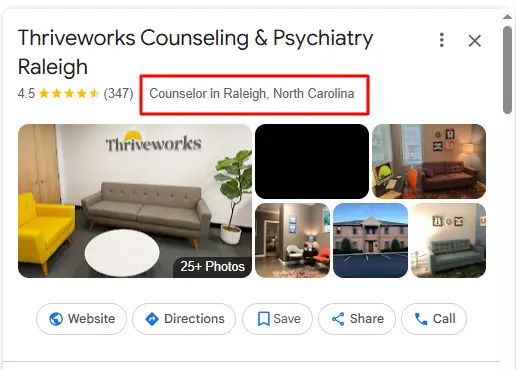
Or you can take my help to choose the right category for your business.
As for the best practices, I recommend:
- Use one accurate primary category and,
- Add no more than 2–3 tightly relevant secondary categories
and after doing this:
- Add all services in the Services tab using clear, human-friendly wording
- Maintain 100% NAP consistency between GBP and your website
This way Google sees your clinic as credible, structured, and trustworthy.
The outcome, it directly increases your visibility in the Local Map Pack and helps you reach patients more efficiently as compared to your competitors.
The “Open Hours” Factor :
“Business Open at Time of Search” is a direct ranking factor.
But most businesses overcomplicate this!
If you are an outpatient behavioral health clinic and your clinic remains open from 08:00 am to 05:00 pm then so be it.
The research shows if your GBP is ranking #01 in your opening hours, you might not have the same rankings after 08:00 pm (in fact you can expect a decline).
But that is Ok!
There is no need to show the office opened when it isn’t!
Some SEOs feel that we should do it, but with compliance and other things in mind, I don’t recommend this.
Just ensure your hours are accurate!
Strengthen Trust & Engagement Signals
Local SEO is heavily dependent on Google Business Profile aka GBP.
To make it stand out in Local Map, you have to make sure that it’s engaging and looks trustworthy.
There are some ways to do so. This includes:
- Photos: Upload real photos of your therapy office, waiting area, and licensed therapists. No stock photos of smiling models in lab coats patients (and Google’s AI) can spot fakes instantly.
- Q&A: Pre-populate your Q&A section on GBP with real questions.
- Q: “Do you accept the Blue Cross?”
- A: “Yes, we accept Blue Cross and offer direct billing.”
What NOT To Do (The Risk Zone)
I see clinics in an attempt to get better results, do over optimization of their Google Business Profiles.
They stuff keywords into their business name (e.g., naming the listing “Best Therapist & Anxiety Counseling in Austin“).
While the data shows this technically helps rankings, it’s also a Risk Factor that causes suspension.
For therapy clinics, getting your profile suspended isn’t worth the risk. Stick to your legal business name.
Or register these keyword stuffed names as Doing Business As (DBA).
Website + Content Optimization for Better SEO Performance
If your GBP is your storefront, your website is your digital brochure. According to the local SEO research, the #1 factor for ranking in organic local results is having a Dedicated Page for Each Service.
Build a High-Authority Website Structure
One of the common mistakes I see again and again is, most healthcare clinics list all their treatments on a single “Services” page.
Google needs to see you as an authority on specific topics.
Instead of one page listing “Anxiety, Depression, and Trauma,” build:
- clinic.com/anxiety-therapy-austin/
- clinic.com/depression-counseling-baltimore/
- clinic.com/emdr-therapy-tucson/
This creates a clear signal to Google that you are a relevant answer for specific queries.
I have done this repeatedly and the growth it brings is worth the effort.
Content That Google + AI Trusts
For almost 60% of informational queries, Google generates AI-based answers called AI Overviews(AIOs).
I have outranked authoritative websites like Verywell Mind and Mayo Clinic in AIOs.
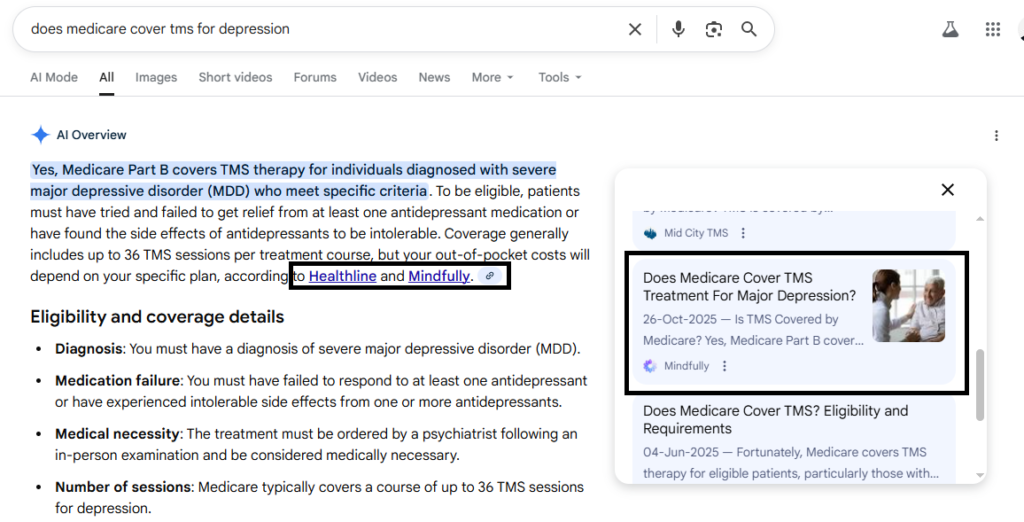
Google rewards content that is thorough and matches search intent.
Domain authority (DA) matters, but I have outranked domains that were x5 more powerful than ours, so I don’t think DA is an absolute thing.
Domain Authority (DA) is a search-engine ranking score that predicts how likely a website is to rank in Google search results compared to other sites.
Good content, backed by good research and really good SEO can help you rank in AIOs.
Technical SEO Essentials To Implement
A fast loading website, free of bloating is a pre-requisite.
Decent sitemap and a sound robots.txt is mandatory.
A sitemap is a file (usually
sitemap.xml) that tells search engines which pages on your website exist and should be crawled and indexed, along with helpful details like last update date and priority.
robots.txtis a file that tells search engines which pages or sections of your website they are allowed or not allowed to crawl.
Make sure your “Book Now” button is above the fold on mobile. If a patient is in pain or anxious, they don’t want to scroll to find your phone number.
How To Dominate AI Search Optimization
You can ask that we are here for local SEO, then why AI-Search is being discussed here?
Well, this is the biggest shift I’ve seen in the last 12 months.
Users are now using AI-based answers to check the validity of local map results.
That’s why I think it’s essential that we combine AI search visibility with local SEO.
Many experts talk about AI Search Visibility factors, but here is what matters the most:
Citations Are The “New” Links
For years, many thought directory listings (citations) were dying. But for AI search, they are back. According to data, prominence on key industry-relevant domains is a crucial factor for AI visibility.
Ensure your therapy clinic is listed on therapist-specific platforms such as Psychology Today, TherapyDen, GoodTherapy, Zencare, and Open Path Psychotherapy Collective.
AI models cross-reference these sites to verify you are a real authority to trust.
The “Best Of” Strategy
The #1 factor for AI visibility is being present on “Expert Curated Best-Of Lists.”
AI tools love to summarize lists. If a local healthcare blog writes an article titled “Top 10 Physiotherapists in Denver“ and you aren’t on it, you are invisible to the AI summary.
Reach out to local publications or community news sites.
Ask to be reviewed or included in their next healthcare roundup.
Reviews and Reputation Drive Rankings
You cannot survive in 2026 without a proactive review strategy.
According to my observation High Numerical Ratings (4-5 stars) are among the top three factors for conversion.
The “Recency” Rule
A 5-star rating isn’t enough if your last review was six months ago. Review Recency is a significant factor.
Real Example:
A private therapy practice in Syracuse had over 100 Google reviews but hadn’t received a new one in nearly a year, which led to a noticeable drop in local rankings.
After implementing a compliant post-session review request, the practice began receiving 2–3 new reviews per week. Within weeks, their visibility in the local map pack improved significantly.
Do not review gate (asking patients if they had a good experience before sending the link).
Google is cracking down on this.
Get Clean Citations, Trusted Backlinks
As mentioned, citations are fuel for AI.
But for traditional organic rankings, inbound links from industry-relevant domains remain crucial.
- Focus on Quality: A link from the Psycology Today for your clinic is worth 1000x more than a spammy link from a generic directory.
- NAP Consistency: Ensure your Name, Address, and Phone number are identical across the web. If Healthgrades has your old phone number, it confuses the algorithm.
Content That Attracts Patients (and Google Discover )
To rank in 2026, your content must answer questions.
This is what we mean when we use terms like search intent.
Search intent is the reason behind a user’s search, what they are actually trying to accomplish when they type a query into Google.
There are pretty good tools for it like Google Trends.
Instead of a generic post like What Is Anxiety?, create content that’s locally relevant and patient-focused, such as Where to Find the Best Anxiety Therapist in [City Name].
This targets local intent, answers a specific question, and positions your clinic as a helpful local resource; exactly the kind of content Google Discover likes to feature.
Also Read: Multi-Location SEO for Mental Health Clinics
Tracking & Measuring Success (What to Monitor)
Stop obsessing over vanity metrics like “impressions.”
Here is what I track for my clients to ensure we are actually growing the practice:
- GBP Insights: Specifically Direction Requests, Phone Calls, and most importantly Website Clicks.
- Review Growth: Are you getting a steady stream of new reviews month-over-month?
- Local Grids: I use grid tracking tools to see how you rank across your entire city, not just when you search from your office.
- AI Overview Positioning: I manually test key queries to see if our clients are showing up in the AI summaries at the top of the page.
Final Words
Local SEO for Therapy Clinics in 2026 isn’t about tricking the algorithm. It is about mirroring the real world.
If you are a great clinic with happy patients, your digital presence should reflect that. The data tells us that Google rewards specificity (categories), authority (service pages), and trust (reviews/citations).
Clinics that embrace these “boring” but effective fundamentals will dominate the map. Those chasing shortcuts will be left behind.
Ready to get your clinic found? Start today by checking your Primary Category on GBP and asking your next happy patient for a review.