Search is changing fast. Your patients are no longer just “Googling” their symptoms; they are asking ChatGPT for therapist recommendations, and relying on Google AI Overviews to make decisions before they ever click on a website.
This shift has created a high-stakes “winner-takes-more” dynamic. If an AI doesn’t mention or cite your practice in its synthesized answer, you are effectively invisible to a growing segment of high-intent patients.
So, how can you prepare your mental health website for this new era of AI SEO?
It requires moving beyond traditional keyword stuffing and focusing on AI Visibility. Because healthcare falls under the strict YMYL (Your Money or Your Life) category, AI models are trained to be exceptionally cautious. They don’t just look for “good” content; they look for institutional trust, peer-reviewed authority, and clear, machine-readable data.
In this guide, we will dive into the exact steps you need to take to optimize your site. This includes building a third-party “authority echo chamber” to format your medical content so AI bots can’t help but cite it. It’s time to stop just chasing clicks and start earning the recommendations that will define the future of your practice.
Understanding AI Visibility – the Core of AI SEO
Before we can optimize a healthcare website for AI SEO, we must understand the metric; AI Visibility. It refers to how often and how prominently your brand, service, or expertise is mentioned or cited by AI platforms.
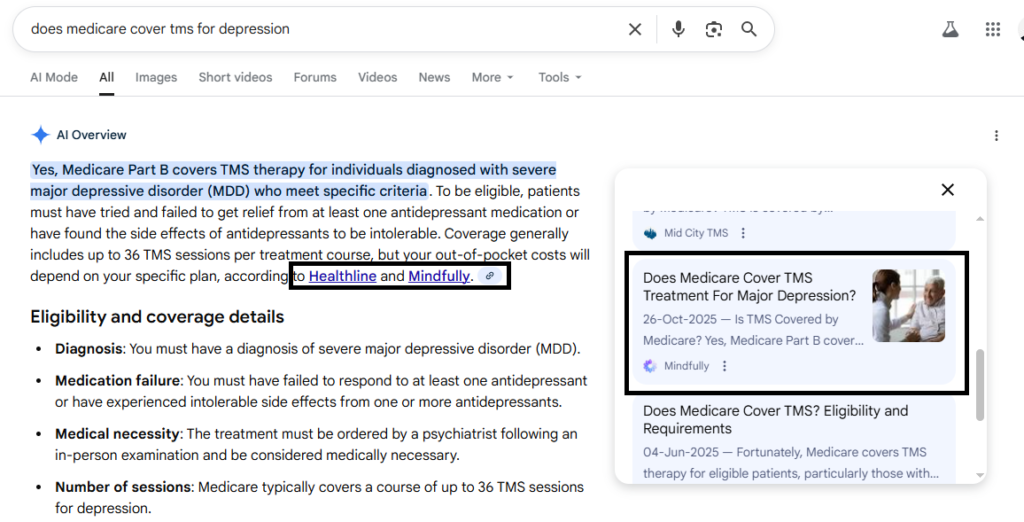
The major players in this space are:
- Google AI Overviews (AIO) & AI Mode : Summarized answers that appear at the top of Google Search
- ChatGPT & Claude: Used for conversational discovery and deep-dive research.
- Perplexity: A dedicated “answer engine” that cites sources in real-time.
In the old world, a user scrolled through ten links. In the AI world, the user is often given a single, synthesized answer with 2-3 supporting citations. This creates a “winner-takes-more” dynamic. If the AI doesn’t mention you, you are effectively invisible to a growing segment of high-intent patients.
Why AI SEO Matters for Mental Health Clinics (YMYL)
Mental Healthcare falls under Google’s strictest content category: Your Money or Your Life (YMYL). Because health decisions carry significant consequences, AI models are trained to be exceptionally conservative. They prioritize institutional trust and peer-reviewed authority over creative marketing.
Data shows that institutional giants like the NIH (~39%), Healthline (~15%), and Mayo Clinic (~14.8%) dominate AI citations.
To a small or mid-sized practice, this might seem daunting.
However, AI also relies on real-time search to provide local and fresh answers. This is where you can win. While you may not outrank the Mayo Clinic for “what is anxiety,” you can absolutely be the AI’s top recommendation for “best anxiety clinics in North Dallas.“
But how, this is what we are going to discuss in this blog.
The Core Pillars of AI SEO
To prepare your website for AI SEO or AEO, you must move beyond keywords and focus on Entity-Based Authority. Here are the four foundational pillars.
A. Build Third-Party Authority (The “Echo Chamber” Effect)
AI models are trained to distrust self-promotion. If your website says you are the “Best Therapy Clinic in Denver Metro,” the AI ignores it. If five independent medical directories, three local news sites, and fifteen Google reviews say you are the “Best Therapy Clinic in Denver Metro,” the AI believes it. To say it in more concise form:
- Expert-Curated Lists: AI tools love summaries. Your primary goal should be appearing on “Best of” lists published by third parties. Reach out to local publications, mommy blogs, or healthcare aggregators.
- Niche Citations: Ensure your practice is verified on healthcare-specific platforms like Healthgrades, Psychology Today, Zocdoc, and Vitals. AI models cross-reference these sites to verify your existence and credibility.
B. Format Content for “Machine Readability”
Large Language Models (LLMs) extract data more efficiently when it is structured logically. If your content is a wall of text, the AI will struggle to cite you.
- The TL;DR Executive Summary: Start every service page or blog post with a “Key Takeaways” box. This provides the AI with a ready-made summary to pull into an Overview.
- Clear Heading Hierarchy: Use H1, H2, and H3 tags not just for aesthetics, but to create a logical “map” of the topic.
- Data-Rich Tables and Bullets: AI models prioritize structured data. If you are comparing two types of therapy (e.g., CBT vs. DBT), use a table. It makes your content the most “citable” source on the web.
C. Prioritize High-Citation Content Formats
Certain types of content are “AI-bait.” Research by Ahrefs shows that AI models are significantly more likely to cite:
- How-to Guides: (e.g., “How to prepare your child for their first therapy visit.”)
- Comparison Pages: (e.g., “TMS vs. Anit-depressents: Cost and Timeline.”)
- Original Research: If your clinic conducts a small survey on patient wellness trends, publish the data. Original stats are one of the strongest magnets for AI citations.
- Definitions & FAQs: Explicitly answer the questions found in the “People Also Ask” section of Google.
D. The “Therapist-Led” Video Strategy
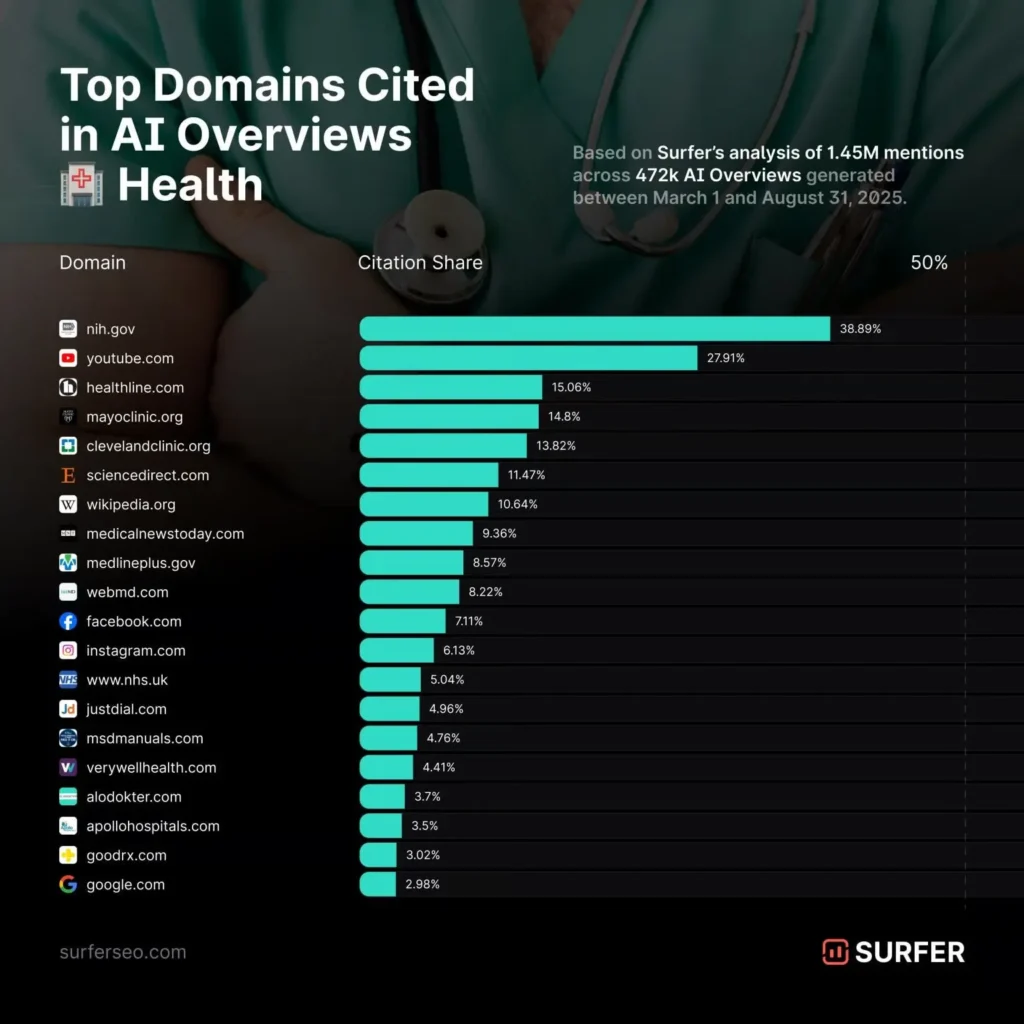
In the healthcare sector, YouTube accounts for roughly 28% of AI citations when the query requires an “approachable” or “patient-friendly” explanation.
AI models (especially Google’s Gemini) can “watch” and transcribe your videos. Having a therapist explain a therapy on YouTube provides a layer of E-E-A-T (Experience, Expertise, Authoritativeness, Trustworthiness) that text alone cannot match.
Local SEO in the AI Era: Proximity & Trust
For many healthcare providers, the battle is local. Patients typically choose a clinic within a 20-25 minute drive. AI search handles local queries differently by merging Proximity with Reputation.
Also Read: How to Do Local SEO for Therapists (Step-by-Step + Examples)
The Google Business Profile (GBP) is Your #1 Asset
Your GBP is no longer just a map listing; it is the primary data source for AI Overviews in local search.
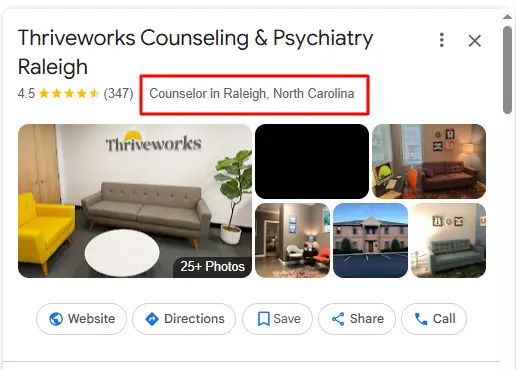
- Category Precision: If you are a mental health clinic, choosing “Psychotherapist” vs. “Mental Health Clinic” as your primary category can change your visibility by 40%. Look at what the top 3 ranking competitors are using and align with the market leader.
- The “Recency” Rule for Reviews: AI models look at the “velocity” of your reviews. A 5-star rating from 2022 is considered stale. To stay relevant to AI, you need at least 2-3 new reviews per week.
- Q&A Optimization: Pre-populate your GBP’s Q&A section with real patient questions. For example: “Do you accept Aetna insurance?” or “Is there parking behind the clinic?” AI pulls these answers directly into search summaries.
Also Read: Multi-Location SEO for Mental Health Clinics
Technical Requirements for AI Crawling
If you block AI bots, you are opting out of the future of search.
- Check Your Robots.txt: Ensure you aren’t accidentally blocking GPTBot, CCBot, or Google-Extended.
- Schema Markup: This is the language of AI. Use MedicalEntity, Physician, and FAQ schema. This allows you to explicitly tell the AI: “This is the doctor, this is their specialty, and this is the specific question this page answers.”
- Fast-Loading Infrastructure: AI search engines prioritize user experience. A site that takes 5 seconds to load on mobile will be deprioritized in favor of a faster, “cleaner” competitor.
Auditing Your AI Visibility (The Manual Check)
Auditing is an essential part of Healthcare AI SEO. As a Mental Health SEO Consultant, I can tell, you don’t need expensive tools to start. I recommend my clients and I perform a “Manual AI Audit” once a month:
- Ask the “Best” Questions: Go to ChatGPT and Perplexity and ask: “Who are the best therapists for postpartum depression in [City Name]?”
- Observe the Citations: If you aren’t mentioned, who is? Click the sources the AI provides. These are the websites you need to earn a link or a mention from.
- Identify the “Mention Gap”: If your competitor is mentioned because of a local news article from three years ago, you now have a PR goal: get a similar local news feature.
- Check for Hallucinations: Does the AI say you offer services you don’t? Does it list the wrong phone number? This usually stems from inconsistent NAP (Name, Address, Phone) data on old directories. Clean these up immediately.
Tracking Success: Beyond Clicks and Rankings
In the AI era, we must expand our KPIs. Success now looks like:
- Branded Search Demand: If an AI recommends you, the patient will often perform a new search for your specific brand name. An increase in branded search is a direct result of high AI visibility.
- AI Share of Voice: What percentage of prompts in your niche include your brand?
- Click Quality: Visitors referred by AI platforms like Perplexity often stay longer and convert at a higher rate because the AI has already “vetted” you for them.
Final Thoughts
Preparing your mental healthcare website for AI SEO is not about “tricking” an algorithm; it is about becoming the most trustworthy, most citable, and most accessible answer to a patient’s problem.
Right now, most of your competitors are still obsessing over keyword density and meta tags. They are ignoring the fact that the search engine is becoming a “suggestion engine.” By focusing on Third-Party Authority, Structured Content, and E-E-A-T, you are building a moat around your practice that will last for years.The opportunity here is timing-based. Early adopters of AI visibility will benefit from the “First-Mover Advantage,” securing their place in the training data and AI summaries while the competition is still catching up.